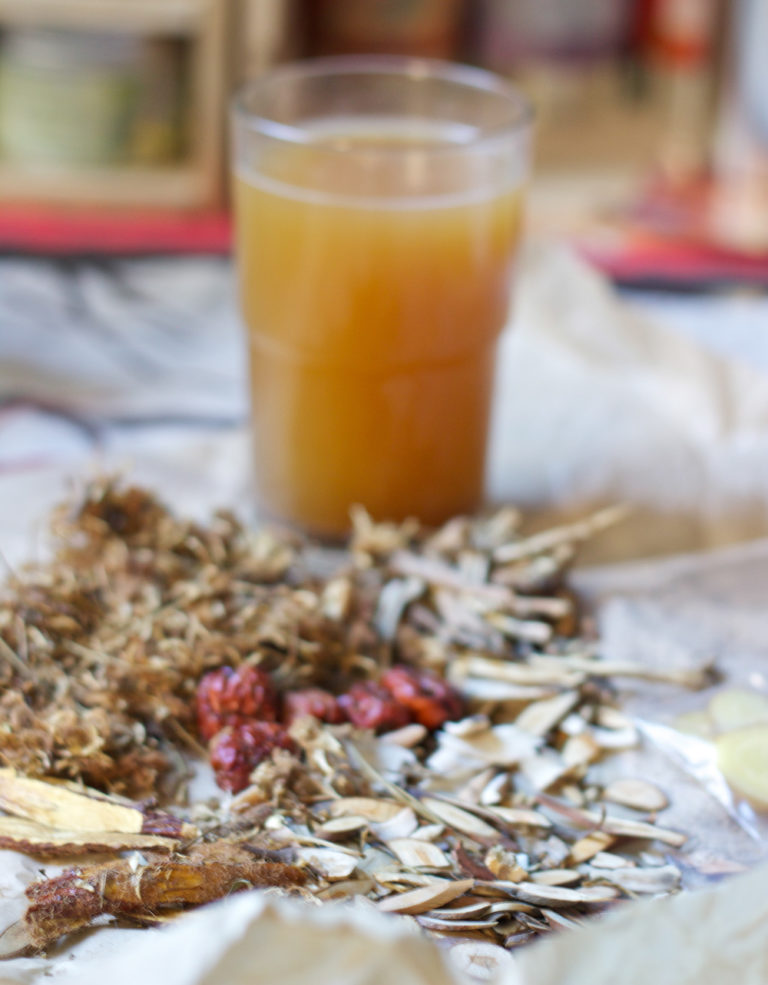

Take a Breath Tea with White Horehound, Magnolia bark and Elecampane
Herbs to help with breathing, a weak voice, diminished Lung Qi and shortness of breath

One afternoon I was in my office, attempting to film a video, but my lungs and throat were so weak that my voice threatened to go out. I could barely croak out a sound!
I had already had shortness of breath/dyspnea for a couple weeks. This is a fairly common symptom of the chronic Mycoplasma pneumonea infection I have, which was flaring at the time.
Usually you think of a bothersome throat as being either dry or phlemgy, but this was one of those times where it was a mixture of both. My throat was dry and sore, but with patches of warm phlegm coming through. Same with my (super weak and infrequent but still present) cough: dry and irritated, but with some congealed dampness mixed in.
When I spoke, my voice was weak, thin and parched sounding, but a frog would come up needing to be “a-hemed” out. This must be what Jill Stansbury called a “hemming cough” (I’m sure she had a specific remedy for it – but I don’t recall what it was ;).
Besides the mixture of dryness and dampness, most of all I had a heaviness and weakness in the chest/Upper Jiao*/Upper Burner. I had no oomph in my chest. In fact, I could hardly hold my shoulders up; my chest instinctively rounded and hallowed like a cave.
*A little note about the Upper Jiao aka the Upper Burner:
It is the area above the diaphragm and contains the heart and the lungs. A type of Qi called Zhong Qi or Gathering Qi is held in the Upper Jiao. Zhong Qi a combination Qi from the air and Qi from digesting food. The two ways we acquire Qi throughout our lifetime is through breathing and digesting.
The type of Qi we are born with is called Yuan Qi and means Original qi, Source Qi, Congenital Qi. The Middle Jiao is the digestive organs, and the Lower Jiao is elimination and reproductive organs.
Seeking helpful breathing herbs
Since I was already in my office where my herbs are, I looked around my shelves for some sort of herbal breath support. Once I spied at the jar of white horehound, I perked up. The memory of the smell of this plant in the garden is enough to remind me what a nice full breath feels like, smells like, and tastes like.
Then the lung tonics came into mind, then the magnolia bark followed … then the warmth and sweet soothing taste of anise seeds stirred my senses, and it came together from there.
The tea below is what I came up with that day. I am still working out a better name, but for now a placeholder name is Take a Breath tea with White Horehound, Magnolia and Elecampane.
White horehound is a potent herb. It’s not particularly harsh, but it is really bitter and somewhat acrid. The taste comes up and bites you! That is what I like about it, what makes it such an effective Mint family plant for opening the Qi dynamic of the Lungs. When I first did a plant sit with white horehound years ago, the impression I got from it is that it initiates the breath.
More about white horehound and the rest of the herbs below, but for now let’s introduce the formula.
Take a Breath Tea with White Horehound, Magnolia and Elecampane
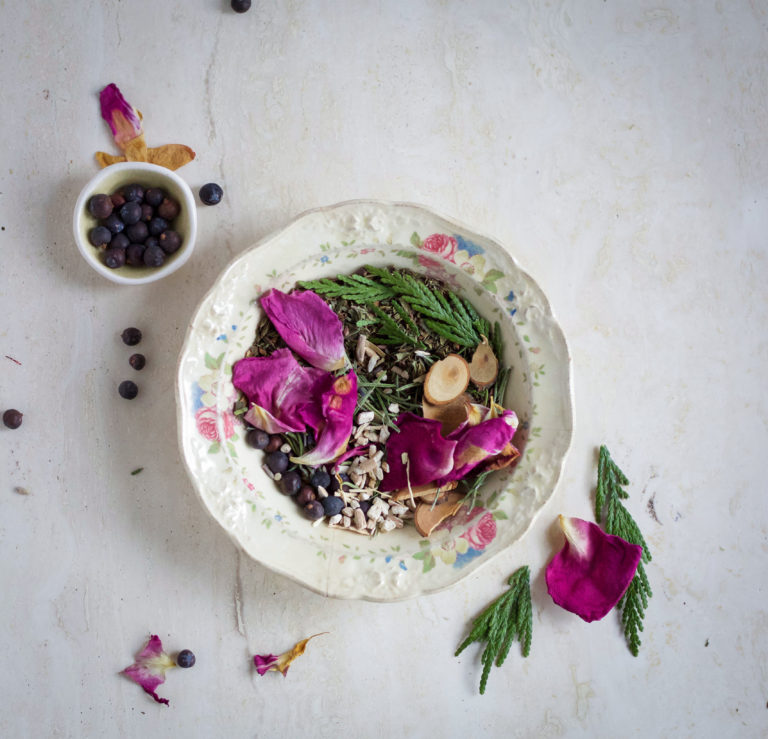
- Magnolia bark/Hou Po – Magnolia officinalis
- Elecampane – Inula helenium
- Mullein leaf – Verbascum thaspus
- Coltsfoot – Tussilago farfara
- White horehound – Marrubium vulgage
- Anise seed – Pimpinella anisum
- Cedar tips – Thuja occidentalis
- Lily bulb/Bai He – Lilium spp.
- Pink rose buds – Rosa spp.
- Cinnamon bark – Cinnamomum verum
- Honey fried licorice/Zhi Gan Cao – Glycyrrhiza glabra
- Jujube date/Da Zao – Ziziphus jujuba
I see this tea more as an inspiration rather than a strict recipe. On a more practical note it could serve as a model of a tea you could make at home with herbs you have. I have herbs that I love and use, and you’ll have yours. Without a doubt you can make an excellent tea (or tincture formula if you want 🙂 without these exact herbs lying around.
That being said, it IS a solid tea formula in my opinion, and I’ve made it a number of times and given it to a few different people. If you do want to try it, I recommend ordering Chinese herbs from the website 1st Chinese Herbs. For bulk herbs, I like organic herbs, and herbs in general from NuHerb and Spring Wind)
I am also in clinical herbal practice (and acupuncture, for people in the Portland area 🙂 and could formulate this tea or one similar, based on your individual needs and goals. Send me an email if you’d like to schedule info@chronicallywell.com.
Directions for Take a Breath Tea
Gather herbs you like for supporting the lungs and chest and voice – or whatever dynamics you’d like to work with. Write a little formula if you wish.
Add a bit of each of the herbs to a pint mason jar.
Cover with boiling water, stir briefly, cover and steep 20-30 mins.
Strain and drink 🙂
I’m big on re-steeping. Steep again later that day or the next.
Herbal categories for your consideration:
Lung tonics Mullein, Coltsfoot, Lungwort
Energetic, emotional or nervine support for the Lungs and Heart Whatever you like, could be any number of nervines or nourishing herbs/tonics:
Soothing herbs for the throat Licorice, Marshmallow, Echinacea, Red Root, Collinsonia…
Perhaps immune-type support for underlying physical issues, like if you are recovering from a sickness, Clear Toxic Heat herbs like Echinacea, Red Root, Cleavers, Oregon Grape, Figwort, Red Clover, Cleavers, Violet, Calendula…
Specific upper and lower respiratory herbs like Horehound, Thyme, Elecampane, Angelica archangelica, Hyssop, Wild Cherry, Pleurisy Root…
Harmonizers to unite the formula – Licorice, Jujube date/Da Zao, Rose petals
Flavor and energetic enhancers/directors – Cinnamon, Ginger, Orange Peel, Licorice, Cardamon, Anise seed, Peppermint, Spearmint, Fennel…
My personal take on tea steeping
Much of the time, I add somewhat large amount of the herbs to a jar and steep and re-steep it a few times with the same herbal tea material. I often put a cover on the jar and save the tea material to be re-steeped the next day, or I will re-steep the tea and let it sit in the water overnight, like a long step, then strain and warm to a pleasant drinking temperature on the stove top.
I especially like to do this when I am using harder herbs like roots, seeds, berries and so on. They impart so much more texture (maybe better described as body or mouth feel), flavor and even action after being steeped a couple times.
Speaking of…
Why I use roots in herbal infusions
It may seem against herbal tea making 101 rules to use a root or other hard herb in an infusion. And you would be correct to say there’s no way a hard herbs is going to fully extract into an infusion.
I certainly do not claim that an infusion is adequate for hard herbs to be a fully medical water extract.
Then why do I do it?
Mostly for space holding, adding particular flavors (which have actions and guidance within a tea, even if it’s not techinally medically strongest), adding a grounding action to the tea (roots are often, but not always, heavy and energetically weigh a formula down).
Please check out this blog post here for more info about it 🙂

A note on Root and Branch – when to address symptoms versus addressing the root of the problem
Making a tea to help you feel ease and relief in the moment…that’s is where herbalism can really shine, in my opinion. This herbal tea for addressing helping my shortness of breath, invigorating the Lung Qi and soothing the voice was wonderfully helpful for me at the time I created it, and the few other times I have used a variation of it with my family and a client since then.
There is essentially nothing wrong with making an herbal formula, whether it be tincture or herbal tea or even taking herbs in pills, when you want some support for the way you are feeling. It’s okay to address symptoms, in fact it can be very advantageous to help you cope and manage your health and well being at home.
At the same time, it is valuable to consider the entire milieu of what your strategies are, the underlying concerns you may have, diagnoses you have to keep in mind and what not.
A Note about Shortness of Breath/Air Hunger aka Dyspnea
It’s just that in relation to this particular tea, I want to mention that shortness of breath can be a serious or at least a moderately concerning experience. Not always, but you should nonetheless be careful about it. There have been a couple of times I’ve seen people with shortness of breath who ended up going to the hospital and needing a lot of medical support.
Most of the time, however, people who have shortness of breath went to the doctor and there wasn’t much to do about it because it wasn’t an alarming situation. Basically, it was something they had to cope with, and depending on the underlying reason, a specific herb/formula/protocol was put into place on my end to help with this very annoying and somewhat debilitating symptom.
As I mentioned above, shortness of breath is often connected to the Lyme disease co-infection, Mycoplasma pneumoniae. Sometimes it can be really terrible! Once I had 2 years of moderately severe shortness of breath from Mycoplasma in which I had to do a bunch of stuff for. It can be complicated and very stubborn, and debilitating for the client. For those reasons a specific Mycoplasma herbal protocol is something I recommend looking into.
Now shortness of breath/air hunger comes to me every now and then, and I can get out of a slump with a mini protocol and herbal teas like this.
In the past when I was really struggling, a tea like this would be nice for sure, but it wouldn’t of cut it – not at all – I needed so much more of a protocol to address the root of the problem, and for much much longer. Personally I love taking cordyceps (and others) for this type of shortness of breath situation.
The Lyme and co-infection advocate in me wanted to make sure that was brought up 🙂
Now let’s get back to the tea…
Analysis of Take a Breath tea with White Horehound, Magnolia and Elecampane


Here’s the basic formula again:
Magnolia bark/Hou Po – aromatic herb to help move stuckness
Elecampane – another aromatic herb, “helps the infrim” when recovering from lingering sickness
Mullein leaf – lung tonic, soothes irritated respiratory system
Coltsfoot – lung tonic; bland, neutral and sour; soothing and strengthening
White horehound – “initiates the breath”, bitter and acrid to open the lungs and get the Lung Qi flowing
Anise seed – warm, sweet, helps move and break up cold old phlegm
Cedar tips – freshening
Lily bulb – soothing to the spirit and emotions, especially those held in the chest
Pink rose buds – combo with lily bulb to address stuck emotions, especially grief and sadness
Cinnamon bark – warming, sweet, cozy; improves the flavor
Honey fried licorice/Zhi Gan Cao – nourishing Qi tonic, warm and harmonizing
Jujube date/Da Zao – helps harmonize the formula and support the Spleen, which is always good to do 🙂
Magnolia Bark/Hou Po – aromatic herb to transform damp, moves stuck Qi

Have you ever smelled a one of those big creamy white magnolia blossoms in the middle of summer? Mmmm…. They smell so good! Other varieties of magnolias smell good, too – my little yellow Butterfly Magnolia certainly does, just not as strongly or as striking as the big Dishpan Magnolias.
Hou Po/Magnolia bark has a unique fresh, acrid aromatic smell too, even though it’s a bark. I am pleasantly surprised that the aromatic nature is so readily imparted into a simple tea, more because it is a hard bark.
It’s because of this smell that made me think about using it in this tea alongside other aromatic herbs, Elecampane and White Horehound.
When an herbs’ use comes to me via Chinese medicine, and the taste, nature (heat or cold level), channels it enters (and organ system affinities) and category it is in is one way to describe an herb from a Chinese medicine standpoint.
Something like this:
Magnolia is a bitter, acrid and warm herb that enters the Large Intestine, Lungs, Spleen and Stomach channels. It is in the Aromatic Herbs to Transform Damp category.
Magnolia’s main action is that it promotes the movement of stuck Qi in the Middle Jiao (stomach area, epigastrium, around and above the belly button) and in the Upper Jiao (chest and ribs) when things are feeling distended and full.
There are at least a half dozen of reasons Qi may be stagnating in the Upper and Middle Jiaos, each with their own expressions/symptomolgy, and Magnolia Bark/Hou Po addresses them all when combined with the other corresponding herbs.
One of the most well known formulas that spills over into common herbalism in the US, even among people who don’t know much about Chinese medicine, is Ban Xia Hou Po Tang, often used for what is called “Plum Pit Qi” which is a sense of blockage of the throat, problems swallowing, a “frog stuck in the throat”, voice issues all of which are often associated with (but not always) anxiety or intense emotions.
Magnolia Gets Qi Moving Down
On that day I mentioned above, I really felt like I couldn’t get a good breath in or out. The breath was energetically “stuck”. When I have a sensation or image of something being stuck in my chest or upper belly that I just wish would more down, particularly with a feeling of dampness/phlegm present, I think of Magnolia.
Qi has different ways that it flows in the body within Chinese medicine, and for the lungs, it should flow down, otherwise it is known as “rebellious Lung Qi”. Coughing, wheezing, shortness of breath, asthma are examples of rebellious Lung Qi.
The warmth of Hou Po dries up dampness, the bitterness directs Qi down, but the acrid aromatic fragrant flavor is what gets the stuck Qi moving. Here’s a quote from Bensky (page 471):
“When dampness and fullness have been eliminated, the Lung Qi will descend smoothly to facilitate breathing, and wheezing [and shortness of breath] will cease”.
Which is exactly what I was looking hoping for!
White Horehound – Helps initiate the breath

See a tip of white horehound steeping at the bottom center of the jar. Even though it was dried, it still maintains some of it’s fuzziness.
A few years ago I planted some white horehound by seed and since then I’ve had plenty of it growing in my garden. It’s such a potent —and bitter!— herb that I only need to harvest it every few years because it a little goes a long way.
I store it in jars in my basement and I think the constant cool temp and darkness keeps it potent for a long time – or maybe that’s just the nature of the plant, because something about it seems protective.
The leaves are hairy and folded and have a fine white fuzz on the surface of the leaves. It does remind me of hoar frost – and touched by the cold but not frozen all the way through. Then there’s something about their intriguingly round shape… okay now I’m getting into a dreamy imaginative state about White Horehound : ) I truly love this plant. It is one of my closest allies and one of the herbs I have an mental/emotional/spiritual/energetic connection with, up there with Thyme, Hawthorn, Rose, Yarrow and so on.
Back to earth about White Horehound…
Whenever I am around white horehound I find myself instinctively taking a deep breath, and the air from that breath fills my lungs so deeply. It’s almost like the same feeling of jumping in really cold water – it’s enlivening.
The phrase my body says about White Horehound is “It helps initiate the breath”.
David Hoffmann says White Horehound is a valuable plant in those with bronchitis with non-productive coughs. “It combines action of relaxing the smooth muscles of the bronchus whilst promoting mucus production and thus expectoration”.
At first I thought I was using White Horehound for more of the energetic properties of opening the breathing dynamic because I was so drawn to it’s bitter and invigorating aromatic nature. But I resonate with Hoffman saying White Horehound works with non-productive coughs and encouraging mucus production, because both of those things I needed help with.
Elecampane – ‘a friend to the Infirm’ as well as acutely infected
Here’s another herb I was drawn to energetically, but then realized I actually was quite needing it’s medicinal support just as much.
This herb is the third aromatic herb of the tea. You may say that it is one or two herbs too many…I say your opinion is valid, but yet I need to stay true to my inspiration and style. Besides, it’s just a little bit to hold space and impart the indistinguishable flavor, drying of dampness and moving of phlegm and Qi.
When I take a tea with elecampane (and a tincture too), I can feel it working in my lungs. It’s because of this physical sensory feedback that wanted to include it here. It’s like it is gently touching my lung area in a most soothing way, and in feeling the touch, the stress, flight flight, weakness, debility, lostness, grief, futility feelings I had been experiencing (I didn’t mention the emotional side of how I was feeling, but in short these were the feelings 🙂 gently began to melt and soften, then transform a bit and move or dissipate out.
Not completely – when you work on the emotional body, but especially with the lungs, things don’t just POOF! Disappear, it’s more like a continual tending process. I kind of see it like taking a little bit out of the emotional stress burden bucket, so it’s not sloshing around, spilling over into the nervous system or rest of the body, but the bucket is going to be refilled again soon if you don’t tend to it again.
Back to elecampane. This remedy has range. It is strong, it is gentle.
Elecampane has a tonic quality mixed in with the antiseptic warming actions. It is, after all, quite mucilaginous. The slimy nature is what I imagine is helping my lungs feel soothed and tended.
I see this plant as a good friend and support to the acutely ill (like with a bad cold or cough or fever) as well as the infirm, weak, convalescing and chronically ill, from childhood to old age. Elecampane is also great for acute infections particularly with lots of mucus to lung stuff without a causative infection and chronic lung issues, like chronic bronchitis, emphysema, COPD, shortness of breath and allergies/chronic congestion.
The presence of Elecampane growing in a garden with their striking orange tops brings me back to a time and place I never knew but feel in my bones. They remind me of medicine gardens of ancient Europe. They look so old and timeless and knowing to me. Christina Stanley says in her book that Elecampane and Wood Betony were the most mentioned and used herbs in written herbal history, and I am not surprised 🙂
Alexis J. Cunningfolk at Worts and Cunning has an excellent writeup called: Sustaining the Spirit : Elecampane Plant Profile. Check it out for historical magical uses, energetic/emotional profile as well as medical attributes of this plant.
CAUTIONS: Avoid during pregnancy, especially early pregnancy.
Take a few hours apart from antibiotics.

Anise seeds – warm and soft, soothing and moving
Thins and moves the mucus. Also helps the flavor, and it’s somewhat of a carminative. Helps the overall flavor too (ahem – white horehound!).
I love adding Anise seeds to all sorts of teas, wether they are for lungs, upper respiratory (like throat or phlegm congestion in the neck/ears) or gut. The flavor is really nice and I find that even people who swear they hate licorice style flavors can tolerate a little anise, if not like truly like it, because the flavor is more mild, earthy and deep and soft at the same time, especially when combined with other flavorful herbs or even just honey.
I like that David Hoffmann says t crush the seeds before steeping, and to give it a short steep. I think doing both of these things will make Anise seeds flavor and actions shine.
David Hoffman’s preparations of Anise seeds:
-crush seeds gently before making a tea to release volatile oils
-pour one cup boiling water over 1-2 teaspoonfuls of the seeds and let stand for 5-10 mins. Take 1-3 cups per day
-to treat flatulence, the tea should be drunk slowly before meals
-one drop of oil in a 1/2 tsp honey
While we are at it, I’ll share the suggestion of ways to combine this herb, too.
David Hoffmann’s Combinations with Anise Seed:
-for flatulent colic with Fennel and Caraway, equal amounts
-for bronchitis with Coltsfoot, White Horehound and Lobelia
Mullien leaf – “very beneficial respiratory remedy”

Quoting David Hoffmann again!
I love to harvest my mullein leaves whole, or close to whole, and store them that way.
I know I am influenced by Chinese herbalism in wanting to keep herbs more intact, because many of their herbs kept whole or in large pieces. Ever since working in the herbal medicinary at O COM (the Chinese medicine/acupuncture school I went to) I thought that was such a neat way to do it, and plus it’s often how we end up harvesting and storing things anyways. It’s often easier to not have to break herbs up.
Anyways, back to mullein. I don’t know why exactly but I love them whole or in big chunks, I feel like they retain some sort of medicinal qualities that I don’t always experience from the light fluff balls of Mullein that I find in commerce. They have a lovely aroma when stored in large chunks or whole leaves too, a whisper of the sweetness of the flowers in bloom comes through.
Mullein is mucilaginous and soothes the mucosa of a dried out, irritated and tickly respiratory system. It helps stimulate fluid production and also facilitates expectoration.
In general Mullein is used when there is some sort of hardness or soreness to the lungs or chest, like a cough that hurts the ribs or just the general lung area. I was not experiencing that at this particular time, instead I was thinking of it more as a general lung tonic.
I consider Mullien, Coltsfoot and Lungwort to be general lung tonics. Overall these are lovely used together or separate and added to any sort of lung formula.
This blog entry is following down the David Hoffmann path today, and I must quote him again:
“Mullein is a very beneficial respiratory remedy useful in most conditions that affect this vital system.”
-David Hoffmann, New Holistic Herbal, Page 217
Coltsfoot – soothes dry and irritable airways
Right after I say I’m going in deep to David Hoffmann I am going to quote Simon Mills on Coltsfoot: He says it is for “Hot, dry cough and for wheezing and shortness of breath” and that it soothes dry and irritable airways, excellent for children’s coughs and nervous spasmodic coughs, and used historically for asthma.
David Hoffmann says “Coltsfoot combines a soothing expectorant effect with an anti-spasmodic action.” Coltsfoot is known for containing Zinc in it’s leaves which possibly contribute to its anti-inflammatory actions. Like Mullein and Lungwort, it is mucilaginous and that must also be a part of it’s soothing qualities.
Coltsfoot is a beautiful little plant. We don’t have coltsfoot growing where I live in the Pacific Northwest (at least not in my neighborhood, I have seen it in medicinal gardens though) but the times I have seen it growing in the wild are like precious memories.
The way the delicate yet full and frisky yellow flower shoot up out of the earth in early spring is so compellingly curious to me. This plant reminds me of England, although I am sure it grows elsewhere…when I get homesick for England (I have a fantasy of moving there even though I’ve only been there once…a year ago today we left for our England trip and I’m still so bittersweetly yearing to go back), I think of Primrose and Coltsfoot.
The funny thing is that a few days ago I read a a blurb about harvesting Coltsfoot for medicine in the young reader series I am devouring called “Warriors” by Erin Hunter. My kids got into them, and I read the first couple aloud to my youngest kid and kept reading them after our read-a-loud session was finished. It’s about a bunch of wild cats who live in the English countryside, and some of the cats are medicine cats. They use herbs and through the whole series you hear a lot of what they use and why. It seems that the uses of the herbs are often older folk uses that maybe you and I wouldn’t think of. Some of the uses of the herbs I question. Some I agree with.
One thing that I appreciate is that the herbs are placed in the right ecosystems and harvested at the right times. I hate it when I see herbs and flowers out of place and time…I had a puzzle that had lilacs blooming and pumpkins ripe at the same time. C’mon!
Anyways, I was pleasantly surprised to read this in Warriors:
“Here and there she glimpsed early signs of new leaf: a few pale snowdrops scattering under a tree, a single early coltsfoot flower like a splash of sunlight against a mossy green trunk. Sqirrelflight reminded herself to tell her sister, Leafpool, where it could be found. Coltsfoot was a good remedy for shortness of breath.” (This is from a book from The New Prophecy series but I can’t recall which one).
CAUTIONS:
Contains PA’s, though lower levels than Comfrey. Use in moderation or not at all if concerned.
And all the rest of the herbs…
Cedar – Offers a sweet, cooling and soothing taste and mouth feel to the tea. Opening to the lungs, yet grounding. I kept it in large chunks to impart the taste and energetic, and a little of the lung stimulating and expectorant qualities, but I didn’t want to to be the main star of the formula, because it can be irritating when there is dryness in the system.
More on Cedar:
Mullein, Cedar and Tangerine Peel: Simple Lung Tonic Tea
Lung Soothing Herbs for Wildfire Smoke Inhalation
Bai He/Lily Bulb – Quoting the myself and adding a bit from an IG story below I made on Nov 25th, 2018 (when I was still on Instagram):
One of my favorite dried medicinal herbs to cook and eat (like in a congee, porridge or soup), as it has a nice texture and taste. Moistening to the lungs, nutritive, calming and heart-centering. In Chinese Medicine their is a pattern called “Lily Bulb Disease” which is a form of melancholia (low mood/depression) which is marked with restlessness and anxiety after being depleted of Nourishing Yin. Yin gets depleted after a draining sickness, intense burnout or some sort of shock or trauma, either acute or ongoing.
Bai He with Hawthorn Berries is a specific combo I have discovered for sleep paralysis or times when the spirit is very prone to being bothered by trickster spirits. Those herbs plus some acupressure on the Ghost Points (specific acupuncture points) has done the trick for stopping sleep paralysis so many times, in myself and herbal clients.

Rose buds – Rose and Bai He/lily bulb are working together to help soothe the emotional body.
Check out these other posts to get a feel for other Rose herbal recipes.
Mentally Uplifting Cedar, Rose and Rosemary Tea Blend
Lavender, Rose and Rosehip Lessons in Herbal Tea Blending
Day 1 Tea with Motherwort, Rose and White Peony
Rose Petal Bandages for Burns and Herbal First Aid
I’d really rather not have anxiety right now: Hawthorn and Motherwort Tea


Jujube date/Da Zao – At first I thought this was overkill – do I need this huge dried fruit as yet another harmonizer in the tea? I mainly use it as that – an herb to help the other herbs play well together and to also gently support the digestion as it is a main Spleen/Stomach tonic herb in Chinese medicine.
But upon drinking the second and third steep of this tea, I realized why it was in here: it makes the entire flavor and action so much more smooth and sweet and gentler.
Zhi Gan Cao/Honey fried licorice – I picked the honey fried licorice preparation because it is more warming (but not hot by any means) and soothing to the lungs, to help guide out old stuck phlegm. Also a harmonizer to the formula…brings it together and helps support the Spleen/Stomach, which further helps the lungs and phlegm/dampness dynamic be more in balance.
Cinnamon bark – warming, circulating, adds a sweet flavor and a dose of comfort
My overall experience with Take a Breath tea
There are so many different types of herbs we can chose from when making a personal tea blend (or tincture, or capsules/supplements). This sounds SOOO CHEESY but I am glad to have tried these particular herbs in this way, and had the opportunity to share them and get feedback with a couple of people other than myself. One of which was my picky kid (I DID add honey to his tea, so that might of been part of it 😉 I could hear it in his voice that the phlegm situation of his lingering cold was shifted to a better place after drinking the tea, although he had a week to go before getting totally well. Elecampane in particular is good for lingering respiratory stuff, but the other herbs helped, too.
What stands out in my memory of this tea is the aroma…the fragrance…and then, the taste. A bit bitter (that’s the horehound!), but yet rounded out with sweet, warm and aromatic herbs, especially after the second steep. Even the bland herbs like coltsfoot and mullein help negotiate a more palatable experience.
Next, I remember the FEEL of the herbs soothing my chest. A subtle sensation, but a present one. And I am left with a feeling of gratitude.
During the time of making this tea, I was having some immune challenges – being exposed to a cold, not getting it fully but I could tell I fought it for a few days because my throat was a little sore and inflammed, plus some nasal phlegms and a slight cough. Plus that shortness of breath and overall fatigue feeling I get my my immunity has to work.
I was also in a time of excavating some deeply held sadness, loneliness and grief, too. My chest held a sense of loss, and for a couple weeks, but for one week in particular while I was PMSing (go figure 😉 I was finally coming in touch with the fullness of the grief, and expressing it. From an energetic standpoint, I could tell this tea helped to hold my weak chest, and fill it a little bit of circulating Qi and vitality. I think the aromatic flavors got things moving, helped them move out, and soothed the emptiness.
This is a word I use all the time, but I can’t help it. Ever since the first time I took herbs back over 20 years ago, I have felt a sense of comfort in their presence, and this tea also brought me that sense of comfort. Particularly in that mug we affectionally call “Birdy Cup”. Birdy Cup also gives me comfort; its’ homemade 90’s style stoneware pottery mug, the kind you’d get a craft fair with the jaunty little bird reminds me of simpler times and teas shared with friends.
Thanks for reading xoxox
Take good care,
Celia